Jim Fairley
A Woman of SubstanceJim Fairley is both a trusted newspaper manager and Paula’s intended partner, joining professional competence to a romance shadowed by the Harte–Fairley feud. Though the supplied scenes show him chiefly through other characters’ accounts, his work and his relationship with Paula make him a point of convergence between Emma Harte’s present responsibilities and the pain she associates with Edwin Fairley.
Identity and Presence
Jim belongs to the Fairley family, whose name carries a history of conflict for Emma. When Paula considers a tour of the northern stores, Emma quickly suspects that the real attraction is Jim, not inventory. Paula first tries to conceal the connection, but Emma knows she is seeing him. Their exchange establishes Jim as a presence powerful enough to shape Paula’s choices even when he is not in the room.
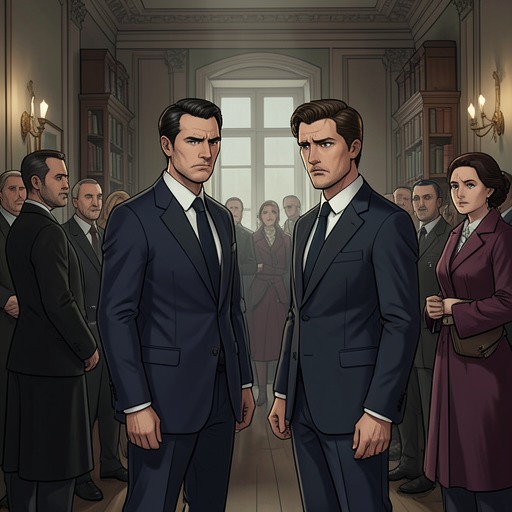
That connection is complicated by Emma’s memory of Edwin Fairley. As she confronts the possibility of Paula’s involvement, Jim becomes inseparable in her thoughts from Edwin, whom she sees vividly and painfully; she describes Jim in her mind as Edwin’s spitting image. The resemblance makes the family feud feel less like a distant grievance than a past returning through the next generation.
Work and Professional Standing
Jim has been appointed managing director of the Yorkshire Consolidated Newspaper Company, and Emma’s confidence in him is substantial: she points to her decision to entrust him with the company as evidence that she trusts him. His management has brought visible changes to the Yorkshire Morning Gazette. He revamped its format, giving it a brighter, more modern layout, and the Yorkshire Evening Standard, also under his control, received similar improvements. Advertising revenue and circulation increased for both papers, and Emma judged his performance an excellent one.
His professional record therefore complicates the old family antagonism. Emma can recognize his ability and rely on his judgment in business even while the Fairley name stirs memories she would rather leave behind. His authority at the newspapers is not merely a personal favor: the improvements and increased returns give her concrete grounds for satisfaction.
Relationship with Paula
Paula admits that she stopped seeing Jim because her feelings had become serious. She feared that continuing would bring eventual heartache to herself and Jim, and pain to Emma, who she believed would never accept a Fairley into the family. Her attempt to protect all three of them had meant concealing the relationship until Emma confronted her about it. Paula presents the separation as a painful precaution, not as evidence that she had stopped caring for him.
Emma’s reaction reveals the emotional cost of that precaution. Recalling Edwin, she is overtaken by sadness and cannot readily answer Paula. Seeing her grandmother’s distress, Paula takes her hand and tries to reassure her that the relationship is over and that she will go to Paris. The scene leaves Paula ready to sacrifice a possible future with Jim rather than deepen the wound she sees in Emma.
Emma’s Change of Mind
Emma eventually tells Paula that she no longer objects to her seeing Jim. She explains that, after reflecting on her life and on the events of sixty years earlier, she does not want an old grievance or the pride of a tough old woman to govern the future of the person she loves most. A conversation with Jim the previous day has also confirmed to her that his feelings remain unchanged and that his intentions toward Paula have always been serious.
Emma then gives the couple her permission and blessing to marry. Paula, who had spent months forcing herself not to hope and pouring her energy into work, is overcome with tears and initially cannot believe Emma has changed her mind. The reversal makes Jim’s significance larger than the romance alone: his relationship with Paula gives Emma an occasion to reconsider whether inherited resentment should determine the younger generation’s choices.